Tropical Fruits
 Peach (Prunus persica) is a species of Prunus native to China
 Peach (Prunus persica) - It has yellow or whitish flesh, a delicate aroma, and a skin that is either velvety (peaches) or smooth (nectarines)
 Peach (Prunus persica) - Yellow-fleshed peaches is acidic with sweetness(Picture is from http://www.handsofhopedisasterreliefservices.org/b2b/pics/Preserved___Dried_Bairen_Peach.jpg)
 Peach (Prunus persica) - Peaches with whitish flesh typically are very sweet with little acidity
(Picture is from http://www.bananagump.com/images/white_peach_in_june.JPG)
 Peach (Prunus persica) - The scientific name of peach is persica. It is derived from a belief that peaches were from Persia (now Iran)
(Picture is from http://www.hort.wisc.edu/mastergardener/Features/fruits/peach/Peach%20Reliance.JPG) Peach (Prunus persica) - The leaves are lanceolate, 7–15 cm long and 2–3 cm broad.
(Picture is from http://lh6.ggpht.com/_XY-tCEzuHSM/Rnqdk9o8gXI/AAAAAAAAAAo/PQy9kO71zNI/DSC02883.JPG) Peach (Prunus persica) - Peaches, along with cherries, plums and apricots, are known as stone fruits (drupes)(Picture is from http://swdesertgardening.files.wordpress.com/2008/06/bonanza.jpg)
 Peach (Prunus persica) - originate in China, and were introduced to Persia and the Mediterranean region along the Silk Road

Peach (Prunus persica) - The flowers are produced in early spring before the leaves. The flowers are solitary or paired, 2.5–3 cm diameter, pink, with five petals. (Picture is from http://upload.wikimedia.org/wikipedia/commons/f/f2/Peach_flowers.jpg)
 Peach (Prunus persica) - A lot of summer heat is required to mature the crop, with mean temperatures of the hottest month between 20 °C and 30 °C
(Picture is from http://www.acclaimimages.com/_gallery/_images_n300/0077-0505-1409-4758_honey_bee_foraging_on_a_peach_flower.jpg)
 Peach (Prunus persica) - Flower bud is easily killed at temperatures between −15°C and −25°C(Picture is from http://billschengdujournal.blogspot.com/2007/03/wuhou-shrine-peach-garden.html)
 Peach (Prunus persica) - Peach flowers are admired by the Japanese but not as much as the sakura (cherry)(Picture is from http://www.realtownblogs.com/uploads/dbrennan_peach%20tree%20001.jpg)
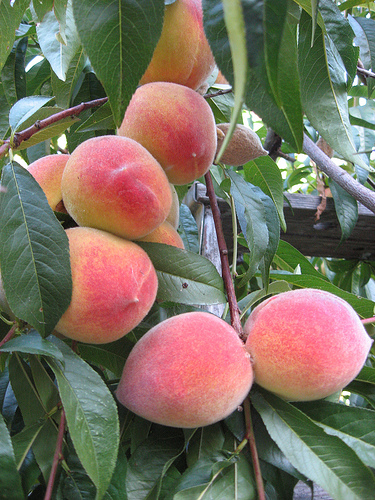
 Peach (Prunus persica) - Every type of peach often have some red on their skin
Peach (Prunus persica) - It bears edible juicy fruit on tree growing to 5–10 m tall
(Picture is from www.mikesblender.com/adventure4.htm)
 Peach plantation - Peach trees bearing full of fruits(Picture is from http://www.williamsstudiogallery.com/PeachAfullPearblos8.21.05.jpg)
Facts about peach
The peach (Prunus persica) is a species of Prunus native to China. Pan Tao, is the Chinese flat peach, which is also called Paraguaya (Paraguayan).
It bears edible juicy fruit on tree growing to 5–10 m tall.
It is classified with the almond within the Prunus, distinguished from the other by the corrugated seed shell.
The leaves are lanceolate, 7–15 cm long and 2–3 cm broad.
The flowers are produced in early spring before the leaves. The flowers are solitary or paired, 2.5–3 cm diameter, pink, with five petals.
The fruit is a drupe, with a single large seed in wooden-like encasement called the "stone" or "pit". The seed is red-brown, oval shaped and 1.5-2 cm long.
It has yellow or whitish flesh, a delicate aroma, and a skin that is either velvety (peaches) or smooth (nectarines). The flesh is very delicate and easily bruised, but is fairly firm, especially when green.
Peaches with whitish flesh typically are very sweet with little acidity. Yellow-fleshed peaches is acidic with sweetness.
Both colours often have some red on their skin.
Low-acid white-fleshed peaches are the most popular kinds in China, Japan, and neighbouring Asian countries. Most Europeans and North Americans preferred the acidic, yellow-fleshed kinds. Peaches, along with cherries, plums and apricots, are known as stone fruits (drupes).
The scientific name of peach is persica. It is derived from a belief that peaches were from Persia (now Iran).
Peaches originate in China, and were introduced to Persia and the Mediterranean region along the Silk Road.
Peach trees can grow very well in environment with temperatures around −2°C to −30 °C. However flower bud is killed at temperatures between −15°C and −25°C. A lot of summer heat is required to mature the crop, with mean temperatures of the hottest month between 20 °C and 30 °C. The trees tend to flower fairly early in spring which is often damaged or killed by freezes, if temperatures drop below about −4 °C.  Peach (Prunus persica) - The fruit is a drupe, with a single large seed in wooden-like encasement called the "stone" or "pit". The seed is red-brown, oval shaped and 1.5-2 cm long.
  Pan Tao, is the Chinese flat peach, which is also called Paraguaya (Paraguayan)
(Picture is from http://www.harvestwizard.com/peach_doughnut.jpg)
 Chinese flat peach - Paraguaya (Paraguayan)
(Picture is from http://www.aonea.com/services/newsletter/peach_donut1_aonea.jpg)
 Peaches, along with cherries, plums and apricots, are known as stone fruits (drupes)
(Picture is from http://www.wikieducator.org/images/3/33/Mcbarnicle-1086969875.jpg)
 Peaches are known in China, Japan, Korea, Laos, and Vietnam for many folktales and traditions
(Picture is from http://www.mca-america.com/Peach.jpg)
 Due to its delicious taste and soft texture, in ancient China "peach" was also a slang word for "young bride"
 (Picture is from https://blogger.googleusercontent.com/img/b/R29vZ2xl/AVvXsEhtDHnoYS1AosjkjaRj7FuI5eI4exk3cA30Ivk2JoVygX_MwGt1tWgN5P9eMrJ6SVYpz3Z_AQZzCzwtd1KLNSYk8k6DObT3nlZPManYMQb4Lo9DhiJPOhJr5_Fhj7n9Q172OeApw-nKlVHk/s1600-h/peachDSC03644.JPG)
 It was in an orchard of flowering peach trees that Liu Bei, Guan Yu, and Zhang Fei took an oath of brotherhood in the opening chapter of the classic Chinese novel Romance of The Three Kingdoms
(Picture is from http://maggiesfarm.anotherdotcom.com/uploads/peach0734002.jpg)
 Momotaro, one of Japan's most noble and semi-historical heroes, was born from within an enormous peach floating down a stream. Momotaro or "Peach Boy" went on to fight evil and faces many adventures.
 (Picture is from http://members.aol.com/hsent/images/Scenic/FLOWERSGardens/OurYard/OnePeach.jpg)
 Elder Zhang Guo, one of the Chinese Eight Immortals, is often depicted carrying a Peach of Immortality.(Picture is from http://farm1.static.flickr.com/228/481708575_3a7d89a2a2_o.jpg)
 The peach often plays an important part in Chinese tradition and is symbolic of long life Peach folktales and traditions
Peaches are known in China, Japan, Korea, Laos, and Vietnam for many folktales and traditions.
Momotaro, one of Japan's most noble and semi-historical heroes, was born from within an enormous peach floating down a stream. Momotaro or "Peach Boy" went on to fight evil and faces many adventures.
Peach flowers are admired by the Japanese but not as much as the sakura (cherry).In China, the immortals consumed peach to obtain longevity. The divinity Yu Huang, also called the Jade Emperor, and his mother called Xi Wangmu also known as Queen Mother of the West, ensured the gods' everlasting existence by feeding them the peaches of immortality. The immortals residing in the palace of Xi Wangmu were said to celebrate the Pantao Hui or "The Feast of Peaches". The immortals waited six thousand years before gathering for this magnificent feast. The peach tree grow leaves once every thousand years and it required another three thousand years for the fruit to ripen. Ivory statues depicting Xi Wangmu's attendants often held three peaches.The peach often plays an important part in Chinese tradition and is symbolic of long life. One example is in the peach-gathering story of Zhang Daoling, who many say is the true founder of Taoism.
Elder Zhang Guo, one of the Chinese Eight Immortals, is often depicted carrying a Peach of Immortality.
The peach blossoms are also highly prized in Chinese culture, ranked slightly lower than mei blossom.It was in an orchard of flowering peach trees that Liu Bei, Guan Yu, and Zhang Fei took an oath of brotherhood in the opening chapter of the classic Chinese novel Romance of The Three Kingdoms.Due to its delicious taste and soft texture, in ancient China "peach" was also a slang word for "young bride", and it has remained in many cultures as a way to define young women or a general state of goodness(as in English, with peach or peachy keen).
 Folktales and traditions - In China, the immortals consumed peach to obtain longevity(Picture is from www.mikesblender.com/adventure4.htm)
 Folktales and traditions - The divinity Yu Huang, also called the Jade Emperor, and his mother called Xi Wangmu also known as Queen Mother of the West, ensured the gods' everlasting existence by feeding them the peaches of immortality.(Picture is from www.mikesblender.com/adventure4.htm)
 Folktales and traditions - The immortals residing in the palace of Xi Wangmu were said to celebrate the Pantao Hui or "The Feast of Peaches"(Picture is from http://www.postcardsfromla.com/mtarchives/pix/jun2003/peach-tree.jpg)
 Folktales and traditions - The immortals waited six thousand years before gathering for this magnificent feast. The peach tree grow leaves once every thousand years and it required another three thousand years for the fruit to ripen. (Picture is From http://www.homestead-farm.net/photos/2007-July%207/47-peaches.html)
 Folktales and traditions - The peach tree grow leaves once every thousand years and it required another three thousand years for the fruit to ripen.(Picture is from http://www.homestead-farm.net/photos/2007-July%207/48-peaches.html)
 Folktales and traditions - Ivory statues depicting Xi Wangmu's attendants often held three peaches(Picture is from http://www.victoriananursery.co.uk/fruit_and_nut_trees/fruit_trees/peach_tree_darling/l/peaches.jpg)
Folktales and traditions - One example is in the peach-gathering story of Zhang Daoling, who many say is the true founder of Taoism.
(Picture is from https://blogger.googleusercontent.com/img/b/R29vZ2xl/AVvXsEjd_WhOphJ2q9R9dZH7Z3Bqs4b-bOgwRFr6O4eKlgud_h_li6l6Cdb1qZTDN9dFhQMV3CNv_kmNRa-22mshoAzupiabgX5AH-pNGfXlHWO0FDtky2EKaYJAmXdXJXJAwPJx6aFCk-TpK-qI/s1600-h/peachDSC03671.JPG) Folktales and traditions - The peach blossoms are also highly prized in Chinese culture, ranked slightly lower than mei blossom(Picture is from http://soulofthegarden.com/Images/March07PeachBlossom.jpg)
 Folktales and traditions - Peach required another three thousand years for the fruit to ripen(Picture is from http://www.ferrarifarms.com/Peach%20Pictures/Peach_Bloom.jpg)
 Folktales and traditions - Xi Wangmu also known as Queen Mother of the West, ensured the gods' everlasting existence by feeding them the peaches of immortality(Picture is from http://www.ferrarifarms.com/Peach%20Pictures/Big_Peach_Bloom.jpg)
 Health Benefits of Peach - Prevent Constipation and Asthma(Picture is from http://www.millerorchards.com/images/ProductPhotos/peach2.JPG)
 Health Benefits of Peach - Prevent High blood pressure(Picture is from http://www.peach-communication.com/Bilddaten/THE%20PEACH.jpg)
 Health Benefits of Peach - Prevent Gastritis (inflammation of the stomach)
(Picture is from http://k.b5z.net/i/u/2179088/i/plantpics/Peach_Vulcan.jpg) Health Benefits of Peach - Acidosis (deficiency of alkalinity in the body)
(Picture is form http://www.ferrarifarms.com/Peach%20Pictures/Single_Red_Peach.jpg)
Health Benefits of Peach :
(from: http://hubpages.com/hub/Health_Benefits_of_Peach) - Anemia
- Constipation
- High blood pressure
- Gastritis (inflammation of the stomach)
- Nephritis (inflammation of the kidneys)
- Acidosis (deficiency of alkalinity in the body)
- Bronchitis (inflammation of the bronchial tubes)
- Asthma
- Poor digestion
- Bladder and kidney stones
- Helps improve the health of the skin and adds color to the complexion
- Helpful in the removal of worms from the intestinal tract
- May help prevent cancer in organs and glands with epithelial tissue due to its high Vitamin A content
 Peach (Prunus persica) - The trees tend to flower fairly early in spring which is often damaged or killed by freezes, if temperatures drop below about −4 °C. (Picture is from http://www.ferrarifarms.com/Peach%20Pictures/009_6a.jpg)
 Peach (Prunus persica) - Peach flowers are admired by the Japanese but not as much as the sakura (cherry)(Picture is from http://www.ferrarifarms.com/Peach%20Pictures/026_23a.jpg)
 Peach (Prunus persica) - Helpful in the removal of worms from the intestinal tract(Picture is from http://www.millerorchards.com/images/ProductPhotos/peach2.JPG)
 Peach (Prunus persica) - Peach flowers are also highly prized in Chinese culture(Picture is from http://upload.wikimedia.org/wikipedia/commons/f/f2/Peach_flowers.jpg)
 Health Benefits of Peach - Helps improve the health of the skin and adds color to the complexion(Picture is from http://www.ferrarifarms.com/Peach%20Pictures/White_Peaches_in_a_row.jpg)
 Health Benefits of Peach - Prevent Bronchitis (inflammation of the bronchial tubes)(Picture is from http://www.tecnoparco.org/Portals/18/peach.jpg)
 Peach (Prunus persica) - A young peach fruit(Picture is from http://api.ning.com/files/hoETl20**R*FKO-vXiN2KRw*sAkt*e5*XWTSvAFiIho_/peach.jpg)
 Peach (Prunus persica) - A plantation of young peach trees
(Picture is from http://www.hort.purdue.edu/ext/senior/fruits/images/large/peach_tree.jpg) Peach (Prunus persica) - A plantation of young peach trees(Picture is from http://www.homestead-farm.net/photos/2007-July%207/51-picking%20peaches.html)
 Peach (Prunus persica) - A plantation of young peach trees. The peach tree is a small stature, short-lived tree, only reaching about 20 feet in height and living for about 12 years. Most varieties are self-pollinating.(Picture is from http://messythrillinglife.blogspot.com/2007/07/country-peach-orchard-day.html)
Fruit Nutrition FactsPeaches Raw(From: http://www.thefruitpages.com/chartpeaches.shtml)
Scientific Name: Prunus persica
NDB No: 09236
| Nutrient | Units | Value per
100 grams of
edible portion | Sample
Count | Std.
Error |
|---|
| Proximates |
| Water | g | 87.66 | 74 | 0.152 |
| Energy | kcal | 43 | 0 |
|
| Energy | kj | 180 | 0 |
|
| Protein | g | 0.70 | 87 | 0.015 |
| Total lipid (fat) | g | 0.09 | 5 | 0.004 |
| Carbohydrate, by difference | g | 11.10 | 0 |
|
| Fiber, total dietary | g | 2.0 | 0 |
|
| Ash | g | 0.46 | 86 | 0.008 |
| Minerals |
| Calcium, Ca | mg | 5 | 5 | 1.066 |
| Iron, Fe | mg | 0.11 | 84 | 0.010 |
| Magnesium, Mg | mg | 7 | 85 | 0.207 |
| Phosphorus, P | mg | 12 | 84 | 0.356 |
| Potassium, K | mg | 197 | 45 | 5.030 |
| Sodium, Na | mg | 0 | 43 | 0.191 |
| Zinc, Zn | mg | 0.14 | 5 | 0.037 |
| Copper, Cu | mg | 0.068 | 84 | 0.003 |
| Manganese, Mn | mg | 0.047 | 84 | 0.004 |
| Selenium, Se | mcg | 0.4 | 1 |
|
| Vitamins |
| Vitamin C, total ascorbic acid | mg | 6.6 | 5 | 1.115 |
| Thiamin | mg | 0.017 | 4 | 0.003 |
| Riboflavin | mg | 0.041 | 4 | 0.004 |
| Niacin | mg | 0.990 | 3 | 0.025 |
| Pantothenic acid | mg | 0.170 | 0 |
|
| Vitamin B-6 | mg | 0.018 | 2 |
|
| Folate, total | mcg | 3 | 8 | 0.339 |
| Folic acid | mcg | 0 | 0 |
|
| Folate, food | mcg | 3 | 8 | 0.339 |
| Folate, DFE | mcg_DFE | 3 | 0 |
|
| Vitamin B-12 | mcg | 0.00 | 0 |
|
| Vitamin A, IU | IU | 535 | 3 | 31.565 |
| Vitamin A, RE | mcg_RE | 54 | 3 | 3.157 |
| Vitamin E | mg_ATE | 0.700 | 0 |
|
| Lipids |
| Fatty acids, total saturated | g | 0.010 | 0 |
|
| 4:0 | g | 0.000 | 0 |
|
| 6:0 | g | 0.000 | 0 |
|
| 8:0 | g | 0.000 | 0 |
|
| 10:0 | g | 0.000 | 0 |
|
| 12:0 | g | 0.000 | 0 |
|
| 14:0 | g | 0.000 | 0 |
|
| 16:0 | g | 0.009 | 1 |
|
| 18:0 | g | 0.001 | 1 |
|
| Fatty acids, total monounsaturated | g | 0.034 | 0 |
|
| 16:1 undifferentiated | g | 0.001 | 1 |
|
| 18:1 undifferentiated | g | 0.034 | 1 |
|
| 20:1 | g | 0.000 | 0 |
|
| 22:1 undifferentiated | g | 0.000 | 0 |
|
| Fatty acids, total polyunsaturated | g | 0.045 | 0 |
|
| 18:2 undifferentiated | g | 0.044 | 1 |
|
| 18:3 undifferentiated | g | 0.001 | 1 |
|
| 18:4 | g | 0.000 | 0 |
|
| 20:4 undifferentiated | g | 0.000 | 0 |
|
| 20:5 n-3 | g | 0.000 | 0 |
|
| 22:5 n-3 | g | 0.000 | 0 |
|
| 22:6 n-3 | g | 0.000 | 0 |
|
| Cholesterol | mg | 0 | 0 |
|
| Phytosterols | mg | 10 | 0 |
|
| Amino acids |
| Tryptophan | g | 0.002 | 2 |
|
| Threonine | g | 0.027 | 2 |
|
| Isoleucine | g | 0.020 | 2 |
|
| Leucine | g | 0.040 | 2 |
|
| Lysine | g | 0.023 | 2 |
|
| Methionine | g | 0.017 | 2 |
|
| Cystine | g | 0.006 | 2 |
|
| Phenylalanine | g | 0.022 | 2 |
|
| Tyrosine | g | 0.018 | 2 |
|
| Valine | g | 0.038 | 2 |
|
| Arginine | g | 0.018 | 2 |
|
| Histidine | g | 0.013 | 2 |
|
| Alanine | g | 0.042 | 2 |
|
| Aspartic acid | g | 0.117 | 2 |
|
| Glutamic acid | g | 0.106 | 2 |
|
| Glycine | g | 0.024 | 2 |
|
| Proline | g | 0.029 | 2 |
|
| Serine | g | 0.032 | 2 |
|
USDA Nutrient Database for Standard Reference, Release 14 (July 2001)
Peach (Prunus persica) May help prevent cancer in organs and glands with epithelial tissue due to its high Vitamin A content
(From www.mikesblender.com/adventure4.htm)Peach remained in many cultures as a way to define young women or a general state of goodness(Picture is from http://farm1.static.flickr.com/228/481708575_3a7d89a2a2_o.jpg)
 Peach plantation using a Compost Spreader to spread fertiliser (Picture is from http://www.ferrarifarms.com/How%20We%20Grow%20It%20Pictures/Compost_Spreader.jpg)
 Peach plantation using a Weed Badger to trim away unwanted weeds(Picture is from http://www.ferrarifarms.com/How%20We%20Grow%20It%20Pictures/Weed_Badger.jpg)
 Peach plantation using a "Greg Discing" machine(Picture is from http://www.ferrarifarms.com/How%20We%20Grow%20It%20Pictures/Greg_Discing.jpg)
 Peach plantation using a Mowing machine to remove weeds (Picture is from http://www.ferrarifarms.com/How%20We%20Grow%20It%20Pictures/Mowing.jpg)
 Peach plantation using a "Mite Greg" machine(Picture is from http://www.ferrarifarms.com/How%20We%20Grow%20It%20Pictures/Mites_Greg.jpg)
 Enjoying the taste and sight of peach in a peach plantation (Picture is from http://www.mikesblender.com/peach%20four.jpg)
 Hanging branches of fruits in a peach plantation (Picture is from http://www.ferrarifarms.com/Peach%20Pictures/Peach%20hanging.jpg)
 On big peach on top of the tree(Picture is from http://www.ferrarifarms.com/Peach%20Pictures/White_Peach_1.jpg)
 Peach plantation - Peach trees with hanging branches bearing fruits (Picture is From http://lh3.ggpht.com/_II6sSB8B5ns/RrnbOavc3AI/AAAAAAAAAXA/0cLxBZn-1XY/IMGP3030.JPG)Peach plantation - Peach trees bearing full of fruits(Picture is from http://www.williamsstudiogallery.com/PeachAfullPearblos8.21.05.jpg)
Adapted/Quoted from:
- http://en.wikipedia.org/wiki/Peach
- http://hubpages.com/hub/Health_Benefits_of_Peach
- http://newbeingnutrition.com/wordpress/peach-health-benefits-and-nutrition/
- http://www.thefruitpages.com/chartpeaches.shtml
- www.mikesblender.com/adventure4.htm
- http://www.williamsstudiogallery.com
- http://www.ferrarifarms.com
- http://farm1.static.flickr.com
- http://messythrillinglife.blogspot.com
- http://www.millerorchards.com/images/ProductPhotos
- http://www.peach-communication.com/Bilddaten
- http://www.homestead-farm.net
- http://www.hort.purdue.edu/ext/senior/fruits/images/large
- http://api.ning.com/files/hoETl20**R*FKO-vXiN2KRw*sAkt*e5*XWTSvAFiIho_
- http://www.tecnoparco.org/Portals/18
- http://upload.wikimedia.org/wikipedia/commons/f/f2
- http://www.millerorchards.com/images/ProductPhotos
- http://k.b5z.net/i/u/2179088/i/plantpics
- http://soulofthegarden.com/Images
- https://blogger.googleusercontent.com/img/b/R29vZ2xl/AVvXsEjd_WhOphJ2q9R9dZH7Z3Bqs4b-bOgwRFr6O4eKlgud_h_li6l6Cdb1qZTDN9dFhQMV3CNv_kmNRa-22mshoAzupiabgX5AH-pNGfXlHWO0FDtky2EKaYJAmXdXJXJAwPJx6aFCk-TpK-qI/
- http://www.victoriananursery.co.uk/fruit_and_nut_trees/fruit_trees/peach_tree_darling/l/
- http://www.postcardsfromla.com/mtarchives/pix/jun2003
- http://members.aol.com/hsent/images/Scenic/FLOWERSGardens/OurYard
- http://maggiesfarm.anotherdotcom.com/uploads
- https://blogger.googleusercontent.com/img/b/R29vZ2xl/AVvXsEhtDHnoYS1AosjkjaRj7FuI5eI4exk3cA30Ivk2JoVygX_MwGt1tWgN5P9eMrJ6SVYpz3Z_AQZzCzwtd1KLNSYk8k6DObT3nlZPManYMQb4Lo9DhiJPOhJr5_Fhj7n9Q172OeApw-nKlVHk/
- http://www.mca-america.com
- http://www.wikieducator.org/images/3/33
- http://www.aonea.com/services/newsletter
- http://www.harvestwizard.com
- http://www.realtownblogs.com/uploads
- http://billschengdujournal.blogspot.com/2007/03
- http://www.acclaimimages.com/_gallery/_images_n300
- http://swdesertgardening.files.wordpress.com
- http://lh6.ggpht.com/_XY-tCEzuHSM/Rnqdk9o8gXI/AAAAAAAAAAo
- http://www.hort.wisc.edu/mastergardener/Features/fruits/peach
- http://www.bananagump.com/images
- http://www.handsofhopedisasterreliefservices.org/b2b/pics


 Posts
Posts













.jpg)
.gif)





%E5%BA%84%E5%B0%8F%E5%A9%B7+%28zhu%C4%81ng+xi%C7%8Eo+t%C3%ADng%29+-+%E5%A4%A9%E4%B8%8B%E6%88%91%E7%8B%AC%E9%86%89+%28ti%C4%81n+xi%C3%A0+w%C7%92+d%C3%BA+zu%C3%AC%29.jpg)